Showing posts with label reckoning. Show all posts

Tempus Passionis


snapdrive.net


God is in your faces
God is in your voices


A friend of mine was in town this week, but not under the most pleasant of circumstances. (If you could pray for him and his family, that would be excellent.)
We were hoping that we'd have a chance to hook up for a night of revelry fellowship this weekend, but it didn't work out. We did, however, get to talk just long enough to exchange prayer requests — and that was very good.

My friend told me* that it wasn't the change that prayer effected in his life that he was thankful for right now — not the miraculous outcomes, the shifting of time and space to solve his problems — so much as the hope and peace that comes from knowing that his friends are praying for him.

I wasn't quite sure how to respond to that.
Maybe I'm still unsure.
Maybe that's why I'm sitting in a café with a notebook and a pen instead of down the street and around the corner, at the feast. Then again, maybe I'm already at the feast.

Sunday morning, Wednesday evening, it's all the feast. We come together not because our prayer changes the world; we come together and our prayer changes the world.
“What you say to one another is eternal. I mean this. When two of you get together on anything at all on earth and make a prayer of it, my Father in heaven goes into action. And when two or three of you are together because of me, you can be sure that I'll be there."

We are God's face.
We are God's voice.

We are the branches of the vine, and our charitable love, our joyful celebration, our reconciling peace, our enduring patience, our perfectly-timed kindness, our helpful goodness, our tested and true faithfulness, our careful gentleness, and our disciplined self-control are all the fruit of that vine, growing out of us and in our work.

Our hearts are like stones, dry and chiselled and barren. Christ has spoken to the stone, and a wellspring of living water pours out — his water. Tears are something to cherish, like water in a drought; but Christ takes one step further than Moses: Christ takes water and makes it wine. Christ takes a funeral and makes it a wedding feast.

Feasting. That's what God does in us, through us. That's what fruit is for.

And so I feel a hypocrite, sitting here with my notebook and my pen. I stay away from the feast. I go to buy gold, and I go to drink the wine; I take a detour from my highway to change my garment for a robe of glory, but what then? I get back on the highway. I sit in my café, and I ponder it all with a sense of ironic distance.

I've never felt a part of the feast, but my friend reminded me this week that I am a part of it. Every fervent prayer does have great effect, every word of kindness comes at the right moment, and every moment of that patience counts; my fruit is a part of the wine. My life is a part of the feast.
Thanks, e. I hope you got as much out of this as I did.

Come one, come all; let's have a feast!


*the author makes no claim to any accuracy in representations of conversation with actual people, and takes no responsibility for any misapplication of theological, scriptural, or liturgical concepts.


The Hour I Never Really Had

The Hour is coming
Can I feel it come?
Can I hear it go?
That silence sounding...

The Hour is gone now
And all I feel is
And all I hear is
Resounding heartbeat...

Where has it gone to?
Hour I never had
But time I gave you...
And so, not quite gone.

Leaping

Leap years are dangerous.
Yesterday started just fine. It was, in fact, almost ideal. I stuffed two pieces of left-over cake into my mouth as I drove to catch the 7AM bus (talk about a breakfast of champions!) and actually managed to get there on time. I finished one reading (Schiller's The Robbers) on the bus, and was ready to tackle Byron's "The Giaour" on my 30-minute bike ride at the gym. All was right with the world.

I didn't finish all of Byron's 50-some pages on the bike, so I sat myself down in the GSEA lounge with an apple and an orange and a pot of lenten tea (perhaps better known as hot water.) I finished the poem before 9:30, and had half an hour to go back and double-check the things I didn't catch.
At this point, a fellow student walked in and asked what I thought of the prison reform documents.

A substantial pause followed, as I searched through short and long-term memory for some indication of which class I was supposed to read prison reform documents for. I recalled seeing something in an e-mail from Dr. K (the Friday-morning prof), but remembered very distinctly that I had seen Schiller and Byron on the schedule for the 29th.
To make a long story short, it turns out that I had missed or forgotten an e-mail explaining a switch in the schedule; Schiller and Byron are next week.

I found myself in an unprecedented situation, being an entire week ahead in my reading!
Sadly, from another point of view I was also a week behind.
With only twenty minutes until the beginning of class I resigned myself to fate. I managed to fake my way through a three-hour seminar by asking more-or-less intelligent questions about the principles of prison reform that were being discussed.
Waugh.

Thankfully, leap days only come once every year divisible by four years.

This is especially fortunate for those of us who happen to be single gentlemen, given the nearly-forgotten tradition of "The Ladies' Privilege":

Because leap years are seen as unusual events that disturb the otherwise orderly progression of days/months/years, certain beliefs have been attached to them. ... Leap years, according to folk tradition, were the only times when women could propose marriage to men, with this belief often termed "The Ladies' Privilege." Yet even within this hypothesis there was disagreement as to how far it went — a great many of those who encountered this custom did not see it as applicable throughout the length of a leap year, but only to the extra day itself; that is, only to February 29.


Another school of thought held that a man so entreated either had to accept the proposal or pay the refused woman a substantial forfeit for turning her down, such as a silk gown or £100.
... In another form of the belief, men who said no ... attracted ill fortune to themselves. In yet another twist, if the gal who did the asking had failed to wear a scarlet flannel petticoat, or if a corner of the same were not partly visible under her dress, the man who declined would be spared the ill luck that a turn-down would ordinarily have propelled his way.


Someone informed me of this custom yesterday (by way of an informal proposal), but she had obtained her information third-hand, and seems unaware that she might have got a dress out of the deal.

Again, I'm glad February 29th doesn't happen very often.

Big Mistake?

I decided that, in an effort to establish a more regular routine (instead of the roller-coaster of insanity that is presently my life), I should start going to the gym a few times a week.
After all, I'm already paying for it as part of my student fees.
Plus, regular exercise will make me more energetic, or something.

Yesterday I made the first big step: I found out where the gym is. It's not far from the bus stop, which is great. I also found out that I don't have to rent a locker (which makes me wonder why anyone would...)

This morning I rose bright and early with the full intention of getting to the gym by 8:00. My body protested this arrangement, and convinced me that (given the fact that I had finished a good deal of my reading last night) I should be able to sleep another hour or so.
I managed to miss the 11:00 bus by approximately fifteen seconds.

I made it to the gym before 12, found a locker, and proceeded to humiliate myself with various implements of mechanical torture. It turns out that the "Pectoral Punisher" isn't named that way as a joke.
After realizing that every muscle group in my body except my legs is in a sorry state of disrepair, I proceeded to the recumbent bicycle for 20 minutes of reading and a light cardiovascular work-out.
It turns out that Elizabeth Cary's Tragedy of Mariam is actually easier to read when your heart rate is at 180 bpm than while at rest. I'm not sure how that works, but hopefully it works again on Friday. (It's too bad I can't keep going at that rate for much longer than ten minutes...)

The aftermath of my workout, however, was not so pleasant. The feeling of nausea subsided quickly, but my shoulders, back, and legs are still tingling.
I have a feeling I'll regret this plan tomorrow.

On the plus side, I now have a spot to keep my excess baggage during the day. I'm not really sure how that will help me in the long run, as I'll only start bringing more and more books to school instead of reading them at home, but I think I can live with that.

Lent

My life is not a barren wasteland;
my life a garden in season,
full of richness and life.
My garden gives me good things,
and I am thankful for them all,
but some are more dear than others.


So I give up the things most dear to me,
for a season,
and I watch them grow,
and I watch them bloom,
and I watch them ripen,
and I am thankful for them all the more.


And sometimes the things most dear to me,
in the ripeness of their season,
fall to the ground and rot;
I am thankful for them all the same,
and I wait, patiently.


The season of lent is not the season of harvest.
But harvest will come.
And I wait, patiently, thankful for each passing day,
each day more dear than the last.

Just Desserts

Last night, I was reading over some "key verses" I've highlighted in my Bible over the years. I came to Paul's first letter to the Corinthians, and I saw this passage highlighted:

If any man builds on this foundation using gold, silver, costly stones, wood, hay or straw, his work will be shown for what it is, because the Day will bring it to light. It will be revealed with fire, and the fire will test the quality of each man's work. If what he has built survives, he will receive his reward. If it is burned up, he will suffer loss; he himself will be saved, but only as one escaping through the flames.

1Cor 3:12-15


I've always been taught that this paragraph describes the system of reward in heaven. If we do the "right things," we get rewards. Sometimes this passages is combined with Paul's references to "crowns" to make up a typology of rewards that we'll recieve based on forms of service. (Crowns for watching, crowns for martyrs, crowns for purity, crowns for preaching, etc.)
Last night, however, I looked back to a few preceding verses and thought about the passage in a different way:


What, after all, is Apollos? And what is Paul? Only servants, through whom you came to believe—as the Lord has assigned to each his task. I planted the seed, Apollos watered it, but God made it grow. So neither he who plants nor he who waters is anything, but only God, who makes things grow. The man who plants and the man who waters have one purpose, and each will be rewarded according to his own labor. For we are God's fellow workers; you are God's field, God's building.
By the grace God has given me, I laid a foundation as an expert builder, and someone else is building on it. But each one should be careful how he builds. For no one can lay any foundation other than the one already laid, which is Jesus Christ. If any man builds on this foundation using gold...

1Cor 3:5-12

What kind of reward is Paul talking about in this chapter? Is the gold-encrusted monument something that I build for myself? Something I build of myself?
Or am I just another servant? I can plant seeds, or lay bricks, or whatever God has ordained for me to do, but the Gold, silver, and costly stones that are shining in the light of "The Lord's day" aren't mine. Those are the things I do, like Paul, for the people God has put in my way.
In the Kingdom of God, my reward is never my own. My reward is not something to cling to, not something to seek for myself. I recieve a reward that corresponds to my service, but what does that have to do with a "crown of preaching"?


Paul goes on to contrast "the wisdom of the age" with real wisdom, which appears foolish. It's not the wisdom of the age that will last, not posturing and sounding smart and making a name for yourself, but gold and silver and precious stones aren't some kind of private piety, either. Paul's entire message in this chapter is about division in the church--division caused by people trying to do "good works," who are tearing the church apart instead.


Good works don't get you a "reward" in heaven. You may recall that
God isn't handing out candy for the kids who volunteer the fastest. Good works are a reward when, in "the light of day," they don't collapse. If your work--not your piety, your work for the kingdom, in the lives of your brothers and sisters, building on the foundation of their salvation--survives the fire, then you have your reward. And you will know that God takes care of his workers, giving them a just wage.

By the grace of God, those of us who haven't done very much for each other will still escape with our lives--perhaps a bit singed, and no doubt with some kind of regret for lost opportunities, but alive nonetheless. I've given up on trying to deserve my life a long time ago, but I still have hope that someday I might be able to say "well, I'm glad I did the right thing for that person."

Slide

I've been sitting here by the window most of the afternoon, and I've seen no less than five people slip on the icy sidewalk outside the library. (Six if you count the guy who was pulled down by his girlfriend.)

I thought about putting up a big sign in the window to warn people, but I don't have enough tape.
Why is it that one never has enough tape?
(Or cookies?)
(Mmmmmm... cookies...)

In other news, it seems that roses and boxes of chocolate provide very little cushioning for those who slip on icy sidewalks.

(Perhaps cookies would be more effective cushioning?)

On receiving a package from the CBSA

Justice


The final straw has broke' your back
and now sweet songs of snicker-snack
shall make my world a better place
once more

And all the fear and doubt and hate
that makes your life a petty state
is for a season turned to grace
and hope
and good faith.

There Will Be Fatburger

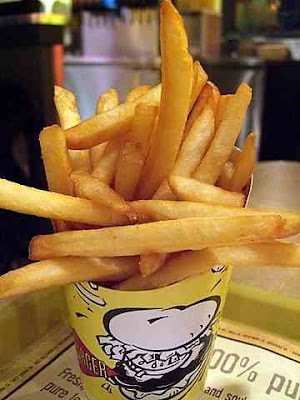
Yesterday marked the end of yet another loooong week, and I finished it off with a good burger and an even better movie.

It was 7PM, and I was going to South Edmonton Common (our city's 300-acre lot of big-box/factory outlet stores) for a movie already, so I decided to find some food there. My original plan was to stop at Superstore for something light and economical, but as I drove up Gateway Boulevard I noticed a Fatburger sign.

When on the quest, the chivalrous knight will often find signs and wonders which lead him off his intended course. Being a knight on a quest, however, means that the course isn't really very well fixed to begin with; after all, questing is just what knights do when they get bored. What else are you going to do with all that land and wealth and stuff? Just sit around a watch profits grow? Trade with/conquer other landowners? Take up a hobby and find out how chickens freeze? These things, I think, bring about a transition from feudal economic systems to mercantilism, from medievalism to renaissance. That is, knights who once ran around questing became wealthy merchants and aristocratic proto-scientists. I fancy myself more a cavalier than a capitalist, so I spurred my charger and followed the red neon sign off the highway and into the mysterious forest of warehouses.

Fatburger has a prestigious history, starting with a "we were the best 'burger stand in town" story and moving to a "value-added" retail concept, working their way into yuppie-traps across the continent. This is exactly the same concept used by Starbucks/Second Cup, only with Hamburgers.

The ordering system at Fatburger is a bit different than what you might be used to: You give your order, pay, take your drink cup and a little sign with your number on it, go get your drink, and sit down to wait for the food. It sounds complicated, but really it's the same thing that Dairy Queen has always done, only with the staff brining your food instead of calling your number. Again, a comparison to Starbucks could be made...

Fatburger was very busy. I suppose this is to be expected at 7PM on a Friday, but I very nearly didn't get a seat. I spotted an opening in a booth, and asked the occupant (name of Rick, surname unknown) if he would mind my company. Sir Rick grunted something which I interpreted as a "yes, but I'm just reading this newspaper so I'm not gonna stop you," and I sat.


None of these details really answer the most important question, though; the most important question for any knight in search of Hamburger is always "howe goode wast this beef sandwiche of Hamburg, m'lord? Wert thine leafes crisp? thine tomatoes ripe and juicy? thine patties beefy?"

The produce was indeed fresh. Crisp lettuce, ripe tomatoes. The relish was good, and in just the right quantity. I didn't notice the onions, so they probably weren't caramelized/raw enough to distinguish from the burger/relish.
The beef is indeed 1/3 of a pound of top-quality lean ground beef. Compared to a fast-food patty from, say, A&W, there's more resistance when chewing, less of an "oatmeal" texture--almost like a nice piece of roast or a rare steak. Flavour was excellent, charbroiled to perfection. Like Harvey's, only with better beef.


The fries do indeed taste more "real" than the batter-coated fries you'll get at most fast-food places, but I kind of like battered fries... These were excellent for what they were. I was really hoping to try Fatburger's onion rings, but they were out. ;_;

The washrooms were so-so. Toilet paper is two-ply, but a bit coarse. Of note were the "tasteful" pin-ups, including Cadillacs, Grace Kelly, Vivian Leigh, and Britney Spears. I left a note on a feedback card that either Britney or Grace Kelly should be removed; Her Serene Highness the Princess of Monaco deserves better company.

All in all, Fatburger is a great place to eat. The breaker, though, is in the price: Fatburger is expensive. Plan to spend more than $12 if you want the whole works. That means you're the price of a drink away from eating at Red Robin's or a restaurant where your non-hamburger-eating friends could order something else. Really, the biggest difference between the two experiences is in having/being able to get your own drink refill. (I know a few people who would see this as a bonus...)
So, Fatburger is worth your while if you want to refill your own drinks.

Basically, the Starbucks of hamburger chains. You can do better, for the same price, if you know where to look and have the time to wait for service.
I didn't think to try the milkshakes... maybe it's worth one more trip next time I'm at SEC...


There Will Be Blood was the highlight of the evening. As the credits rolled, all I could think was that this is the Citizen Kane of our generation. It'll bore some people, but if you've ever wanted to watch a man fall down a mineshaft this is the film to see. The ending was a bit frustrating, but the plot made far more sense than Punch-Drunk Love. (The other P.T. Anderson film I've seen.)
I don't want to say more than that; it's really just a great movie.

Discipline and Punishment: Being a Further Examination of Virtue and Vice

It turns out that my Dostoevsky class ("ENGL 5??: Crime and Punishment") is actually a Foucault class.
What a disappointment. You'd think the guy could have just called it "Discipline and Punishment" instead. I'll be able to work Dostoevsky in if I want to, but he's not on the reading list and the prof. doesn't seem to know much of anything about 19th Century Russian existentialists.

That said, it provides another layer of discourse for my week: I'm now inspired to think about the power structures of virtue, the vices inherent in institutional systems (and our responses to those systems, which seem to incriminate no matter how hard we try to follow the rules) and the cosmic ironies which seem to define modern life.

First, I've found out that the professor in question from my last post is on sabbatical this term. I now recall him/her mentioning this fact at the end of the last term, but I didn't think at the time of the possible ramifications for that fact. Luckily, I have until February sometime to get the appeal rolling, but this month is going by much faster than I imagined it could...

I've also discovered that deadlines, on the whole, are a form of punishment designed to make academics and bureaucrats into criminals and enforcers; on the whole everyone is just a servant of the power structure, which becomes a giant energy-sucking vortex that exists only to continue expanding (and sucking). It seems that each form I fill out in the administrative offices is an exertion of the institution's power over my life. Even the reading assignments take on an aspect of oppression: I made two hundred pages of photocopied reading material today, and I've spent more money than I even want to calculate on books. All this, because I've got to "have the texts." To what extent do I really "have" any of these texts? I can read them more easily than I could before, but what have I actually paid for? Are reading assignments actually something I'm doing for the sake of intrinsic value, or is it a kind of disciplinary action that's forced on me in order to enforce a normative paradigm?
If I don't read Robinson Crusoe this weekend, am I actually losing something, or am I merely incriminating myself? Here's the test: If I didn't read it, would anyone know the difference? If not, then it's probably a criminal act, the breaking of a rule that's enforced by an outside force that relates only to my participation in the power structure of the university. I think that's probably different than real vice, but I'm not sure where to draw those lines.

Virtue, on the other hand, is something I'm quite sure about. I'm still convinced (despite all of the poststructuralism that's been oppressing me these last four years...) that virtue is a power structure that works in an entirely different way than vice and criminal/lawful behavioural conditioning. Perhaps I'll be able to come up with an anti-Foucaultian reflection on the paradigmatic nature of virtue-as-power-structure next time...

On Vice

I've been told that it's now open season for grad students who have a desire to exact vengeance upon evil/disorganized Professors.

A bunch of us got unexpectedly low grades in the class that I hated/liked most last semester, the one which consisted mostly of translating and organizing an unending barrage of weekly e-mails and additional assignments that were sometimes in total contradiction of the course outline. There's a lynch mob forming.

I have no desire to have another professor read my essay, (which, as "creative" and fun to write as it was, is probably worth the B it got at best,) but the fact that there was no feedback or work returned for any other parts of the class (and the fact that the syllabus we got at the beginning of the year makes no mention of grading at all) is something that needs to be called to the attention of University administration.

So, I can be vindictive about the whole thing and write nasty letters to important people about the way the course was taught, and feel guilty because the prof. in question seems to be a very nice person despite any of her other failings...
Or...
I can bombard the prof. in question with letters asking for an explanation of my course grade until she agrees to change it just to make me go away, and feel more exhausted than when I was doing all of that meaningless work in the class...
Or...
I can choose not to say or do anything, and intensify the sense of emptiness that fills all of my University-related nightmares.

*Waugh*

On Virtue

I was reading in the Wycliffe New Testament today, and I came across a rather unexpected bit of word use.
Is seems that in Wycliffe's time, virtue meant far more than an idealized form of ethical orientation; in these passages virtue seems to have a very active dimension.
According to the online etymology dictionary, the same word is translated as "power" in the King James authorized version--which came two hundred years later (~1610.)

Now, it would be easy at this point to say that "in our individualistic and intellectually dualistic understanding of ethics and morality, virtue has lost the sense of embodiment it once carried." I don't want to say that, because I think there's more to it than that. The English society which produced the KJV was certainly more "modern" than the 14th century evangelicalism that Wycliffe preached, but there have got to be further dimensions to this whole thing.
I haven't come up with anything better, though.
*sigh*
What was it that Socrates said? The most important thing to know is that you don't know anything?

Resolution and Redemption

On the first day, e. was in E-town and we went to see Across the Universe at the cheap theater.
And we said that it was good.


And the first day was divided from the second day, and we called the hour of division "midnight," and we were still sitting in the house of Denny discussing Post-Modern narratives and film adaptations.
And lo, the ceiling tiles of the house of Denny were wrapped in colourful paper, (in an alternating pattern, as of a checker-board,) and we said that it was good.

And the server brought e. his cheesecake in a bowl, and e. said that it was an unusual way to serve cheesecake, but he said that it was good nonetheless.

And lo, I greatly desired a milkshake of chocolate, and the servants of the house of Denny produced the milkshake. And they were not out of ice cream, nor was the machine broken; neither were the servants of the house of Denny incompetent in the ways of the milkshake. And I said that it was good.
Thus the year was called into being with omens and mysterious signs; and lo the wind did blow from the southeast, and the world showed her face anew.

And we praised God for his goodness, and spake solemn oaths, and cast off weariness and doubt from the year that had passed.

And it was good.

A Terrible Mistake

Christmas being the second most popular occasion for sale-priced boxes of chocolate (behind Easter and just ahead of St. Valentine's Day, sales figures pulled from the ether surrounding my transcendent consciousness), I'm sitting here now with no less than a kilogram of chocolatey confections.
Is there any such thing as a sugar hang-over? I'll be going well into the night (Mass Effect and Halo 3 with my younger brother FTW) and I dread what tomorrow will bring. Thankfully, there'll be more chocolate in the morning. And coffee. And more Star Trek DVDs to watch with my brother. And more Halo 3 to play. (Brothers FTW.) And then to shed some of that excessive energy, I can go trudge around in the snow for a few hours, come back in, and play more video games (with chocolate.)

That's not what I sat down to write, though...
What was it again?
Oh, right, chocolate.

I just tried some Lindt "Excellence," the stuff specially marketed to pretentious connoisseur types with the country of bean-origin an the box, and it was very good. I compared Madagascar with Ecuador, and found that one of them was slightly smokey and the other more earthy. You have to consume 75% dark in small nibbles and let it melt in your mouth. Chewing a mouthful of dark chocolate is a bit like chugging red wine--not a good idea. Unlike wine-tasting, though, there's no downside to swallowing.

Anyway, after consuming this heavenly bitter chocolate of tropical origin, I went to a box of Hershey's "Pot of Gold: Excellence--Fine Chocolates and Truffles." (That's the gold box.)
Hershey's milk chocolate is vile, in my opinion, but the refined version in Pot of Gold boxes is usually quite good. Not so after tasting the real, dark, sophisticated stuff. All I could taste of this fabled "Pot of Gold" was sugar, maybe with a hint of "milk ingredients" (whatever those are...)

Thankfully, after half a box of the Hershey's stuff I've mostly forgotten what real chocolate tastes like. I've also discovered that I was wrong in my earlier assumption about not feeling any side-effects from swallowing all the chocolate I'm "tasting."

The Tempest

I think I just dropped the biggest bomb of my academic career.
I've been working on this presentation for a week; not really enough time to make something top-notch, but I felt that what I was saying had a significance for the discussions we've been having (about performance of Shakespeare) throughout the year.

After five minutes, I realized that people were avoiding eye contact. That's not a good sign.

Then I was asked to clarify a few of my terms. Then I was asked to clarify them in a different way. Then my whole understanding of the topic-at-hand seemed to collapse under the exasperation of everyone involved. The instructor tried to herd our discussion back to the film we were discussing, but the cat was out of the bag. Nobody seemed to understand my premise, and after explaining it five different ways I started to lose focus and slip into useless generalities. Then the response became somewhat hostile (I think I used the example of extremist feminism too much, extremist conservativism not enough, though strangely the ratio is 1:4 in my notes...)

Are my perspectives on critical theory really that different? I hope not. Maybe I didn't have enough examples. Maybe I used too many examples from the wrong source. Maybe I didn't really know what I was talking about, after all.
In the end, I only spent five minutes of my twenty minute presentation discussing the film, and our circular deliberation about what I was saying took nearly forty minutes altogether.

Good grief. I can only hope that my presentation at the MEMI conference on Thursday is a bit more successful. (At least there I'll be presenting with other medievalists on a topic I'm more familiar with...)

I still can't figure out what's going on. Writing something about the problem usually helps; this time it's not working.

Oh well. I've got other things to worry about.

In Memoriam

I've lost a friend this week, a friend I'd barely known.

RIP
RB Special
"Dayea"

2005-2007

I can only pray that whoever is charged to destroy her will do so with the respect she deserves.

[pours a cup of tea for his lost beloved.]

Red vs Green

NyQuil: Sweet, syrupy nectar of medicated bliss.
NyQuil: It'll make you dream in Technicolor. (Actually I think my dreams lately have had more of a Kodachrome tint, but you get the idea.)
NyQuil: what more need be said?

There's still the most important question, that's what!

Weekly Poll Alert!


RED or GREEN
The RED
The GREEN
Tylenol Blue-Green FTW!
I swallow my medication in capsules, thanks.


Remembering and Reckoning

There's something about memory. The lakeside smells that bring you back to a summer day at camp; the taste of blood in your mouth, accompanied by the flash of emotion from a fistfight with your brother; the unmistakable sound of your grandmother's out-of-tune piano and the gray-brown colour of her hair.
Memory is a trick we play with time and space.

What are we remembering on November eleventh, exactly? Are we remembering the soft, wrinkled faces that have passed out of our lives? Are we remembering the almost-stirring speeches from statesmen who would like us to remember what it means to be "Canadian"? Are we remembering the metallic taste and deafening noise of trench warfare? Are we remembering the smell of church coffee and the stinging cold of a winter morning one year ago, when we stood around that same cenotaph in the middle of town and anticipated the sound of that same bugle, that lonely bugler who tells us our two minutes is over?

I thought about bringing a camera to the Remembrance Day ceremony this year. I had my Yashicamat all ready to go on the tripod. Then, at the last minute, I changed my mind.
Remembrance Day is not a day for pictures, not a day that we should immortalize in our albums or on our websites.
Remembrance Day is a day for memories that are already made.
Remembrance Day, for me, is a day of reckoning. A day of judgment. A day when I stand silent for two minutes and sort through the things I've done, the places I've been, the people I've loved. And after two minutes of remembering, I look at the names on that cenotaph, and then up to the cross that sits on top, and I ask myself if those memories are worth the price that was paid.

I don't think I'll ever be able to answer that question.


snapdrive.net

On Faithfulness and Beating of the Head Into Brick Walls

I'm stuck here again?
Faithfulness is hard. Poetry is easy.
I should get back to work.


Get your own playlist at snapdrive.net!